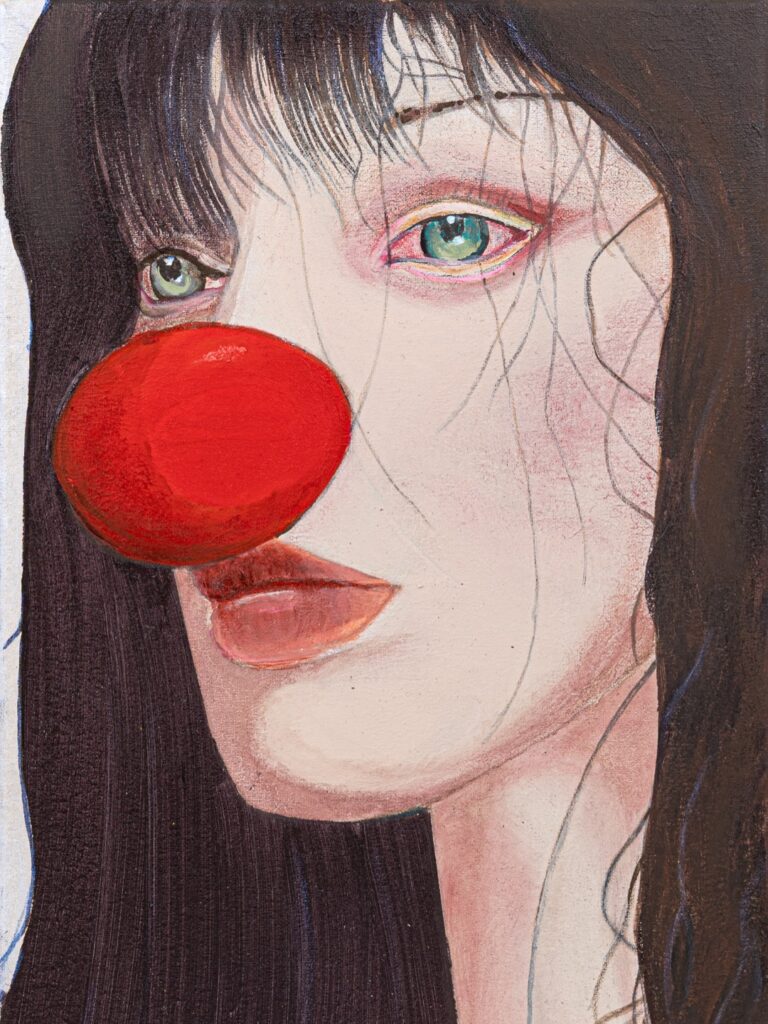
@videoinsightfoundation acquires for the Videoinsight® Collection #videoinsightcollection the work ‘Bella e (simpatica)’, acrylic and oil on canvas, 30 x 20 cm, 2025, by Artist Savina Capecci. The painting was part of the group exhibition “Caregiver,” curated by @rebeccarusso.videoinsight and promoted by @videoinsightfoundation at @magazziniartecontemporanea in Trapani between July 29, 2026, and August 29, 2026.
” ‘Bella (e simpatica)’ is a portrait of a young woman, characterized by
a visual duality. The composition depicts a face with weary features, highlighted by reddish makeup around the green eyes that gives the gaze an almost worn-out quality. The central, dominant element is a red clown nose. This nose — usually a symbol of joy or entertainment — takes on an almost painful, performative connotation. It is the mask that the #caregiver is sometimes forced to wear to project cheerfulness and amiability — as ironically suggested by the title — in order to lift the spirits of the person being cared for, even when their own spirit is exhausted or grieving. The red nose acts like a superficial bandage, concealing the fatigue and the invisibility of one’s own pain. The contrast between the woman’s weary expression and the clown emblem highlights the tension between inner reality and forced performance.” @savinacapecci
The artwork ‘Bella (e simpatica)‘ by @savinacapecci acquired by the @videoinsightfoundation for the Videoinsight® Collection, captures — with raw yet empathetic beauty — one of the deepest and most silent human dynamics: the condition of the #caregiver. Through an authentic and engaging visual language, the work conveys — with extraordinary emotional resonance — warmth, lightness, and a profound understanding of human fragility. The painting transforms the artistic experience into an act of care and comfort. It stands out for its expressive immediacy, depth of meaning, and ability to evoke an emotional response. Through the figure of a woman who is strikingly beautiful yet marked by pain, the artist creates a powerful visual and emotional contrast. The protagonist’s eyes — swollen with sadness and traced by genuine tears — tell a story of depression, loneliness, and physical and mental exhaustion. They reflect the gaze of someone bearing an invisible yet crushing weight, worn down by the daily toil of caregiving. Breaking this tableau of inner suffering is an element that feels alien yet holds immense symbolic value: a clown’s nose. This detail transforms the woman into a living mask. The red nose represents the moral and emotional obligation the caregiver feels compelled to fulfill every day: to act as if nothing is wrong, to wear a forced smile, and to project lightness and cheerfulness in order to lift the spirits of the person in their care. It embodies the paradox of having to be a source of joy and comfort for others precisely while feeling hollowed out inside. The woman’s physical beauty — hinted at in the title —serves as an ironic backdrop to her profound fragility, as she is reduced to the social role of someone expected to always be “beautiful and, above all, cheerful.” Rebecca Russo