Mostre

Sebastiano Sofia

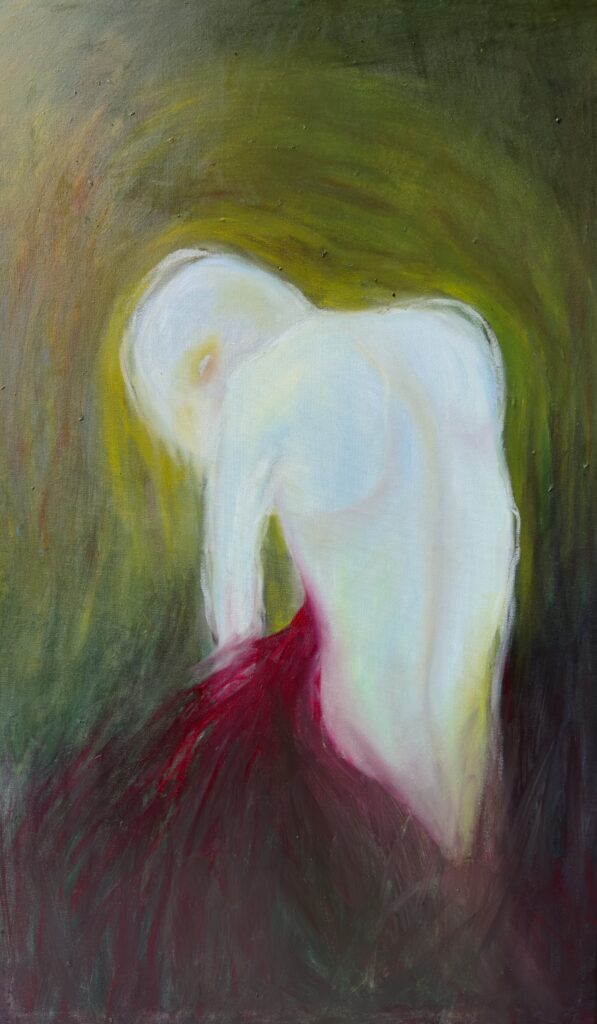
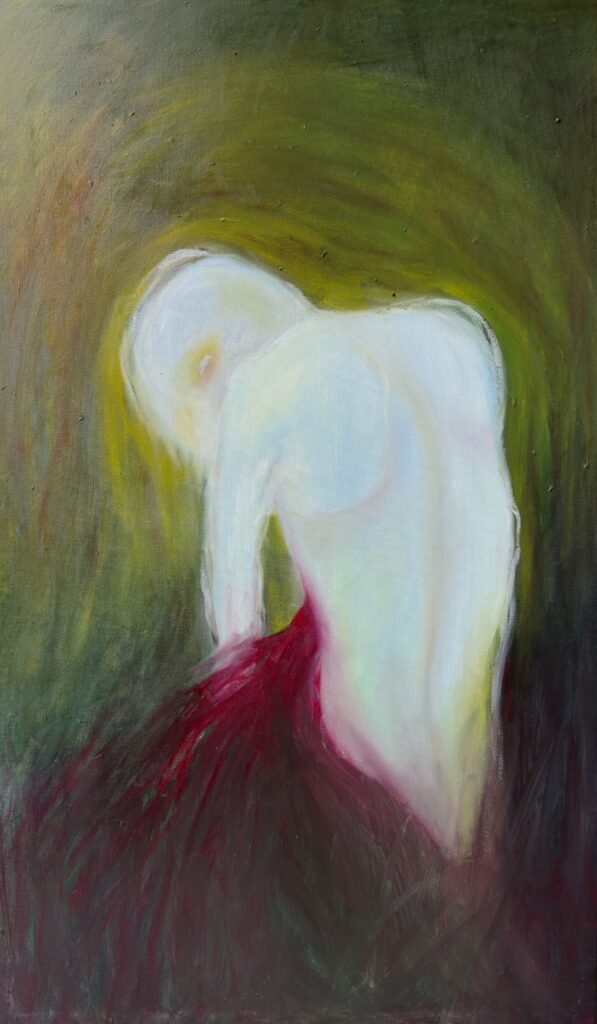
@videoinsightfoundation – ETS acquires the artwork “Self-portrait with stoma” (oil on canvas, 100 x 60 cm, 2026) by Artist @sebastiano_sofia. The piece was part of the group exhibition “Caregiver”— curated by @rebeccarusso.videoinsight and promoted by @videoinsightfoundation— held at @magazziniartecontemporanea in Trapani from July 29 to August 29, 2026.

“This self-portrait stems from the experience of having a stoma, an event that radically transformed my relationship with my body. For months, caring for myself meant performing simple yet essential daily actions: cleaning, dressing the wound, observing, and accepting. It was a ritual defined by fragility, patience, and listening. Yet, this act of #care was not merely physical; it was also a mental and emotional exercise—learning to inhabit a changed body and confronting fear, shame, and uncertainty. I did not walk this path alone. The presence of those who stood by me — doctors, nurses, family, and friends —reminded me that #takingcare is always a relationship, a shared act. This painting was born from that experience: it tells the story not just of a wound, but of the possibility of rediscovering a sense of tenderness toward one’s own body, even when it seems to have become a stranger.” Sebastiano Sofia

“Sebastiano Sofia’s work is distinguished by a fluid, organic, and evocative painting style, in which the human figure dissolves into metamorphic forms. The application of paint is liquid and layered. Body contours are never sharp or rigidly defined; instead, they appear soft — almost gelatinous or membranous — reflecting the fluidity of the body’s interior and the mutable nature of flesh. Sofia’s palette employs organic and flesh-toned hues: shades of pink, visceral reds, pale blue-white tones, and areas of warm or earthy shadow. The color is not descriptive in a realistic sense, but rather emotional and sensorially perceptive. The atmosphere is suspended in time, hovering between the dreamlike and the clinical or anatomical. The figure seems to emerge from or sink into the background, creating a sense of privacy that is simultaneously violated and embraced, where the delicacy of the brushwork softens the impact of the exposed medical condition. His artistic exploration transforms biological fragility and the marks of illness into an act of pure visual poetry. The work aligns with the primary objective of Videoinsight®: using painting as a psychotherapeutic tool to bring deep inner insights to the surface.

In Self-portrait with Stoma — an intimate, visceral self-portrait — the Artist confronts the complexities of the vulnerable body, the nature of #care, and the reclamation of bodily identity. He lays bare his physical and psychological state regarding the presence of a stoma — a permanent or temporary anatomical alteration that radically transforms one’s relationship with their own body. Within the context of the exhibition Caregiver — created to explore concepts of care, dependency, empathy, and physical and emotional support — the painting acts as a bridge between two dimensions: the body as a site of care, where the stoma ceases to be a mere clinical detail and becomes the conceptual core of the work— a symbol of human vulnerability and the need for acceptance; the act of self-caregiving: even before receiving care from others, the figure is immortalized in the act of managing, observing, and inhabiting their own condition.” Rebecca Russo
Selena Leardini

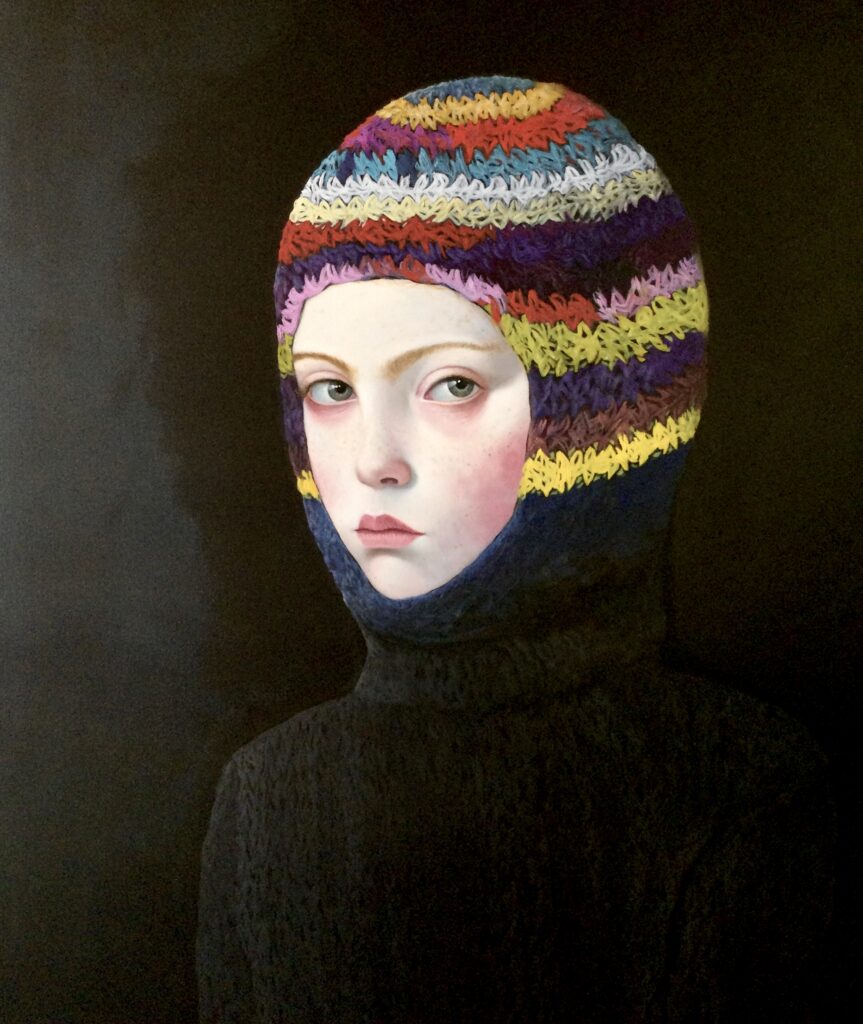
The Videoinsight® Collection acquires the work ‘Nero’ (oil on canvas, 60 x 70 cm, 2026) by Artist @selenaleardini. The piece was featured in the group exhibition “Caregiver,” curated by @rebeccarusso.videoinsight, promoted by the @videoinsightfoundation, and held at @magazziniartecontemporanea in Trapani from July 29, 2026, to August 29, 2026.

“In ‘Nero’ Selena Leardini succeeds in giving visible form to the invisible, illuminating the shadowy recesses of the psyche, and transforming fragility into a precious opportunity for #care and awareness. The work addresses pain and human vulnerability; it transforms darkness into a space for listening, acceptance, and emotional processing. The painting’s psychodynamic, evocative, and conceptual impact stirs a powerful emotional resonance. Through a figurative language that is both delicate and incisive, ‘Nero’ triggers mechanisms of identification and introspection — processes essential to activating the Videoinsight® experience (psychological insight). The addition of ‘Nero’ to the Videoinsight® Collection aligns with a specific curatorial and scientific research direction based on the Videoinsight® Method, which recognizes the artwork as possessing therapeutic value, serving as a transformative resource, and acting as a powerful stimulus for inner growth.” Rebecca Russo

“This work presents itself as an intimate, profound reflection on the theme of #care. It does not depict an explicit action but evokes its essence through a central symbol: the knitted cap. The hand-knitted wool becomes a metaphor for the slow, repetitive, and patient act of caring for another. Every intersecting strand calls to mind the time dedicated to another person — the silent continuity of a commitment that often goes unseen. It is a daily practice that seeks no spectacle, yet builds protection, warmth, and presence. Here, care is not merely physical but also mental and emotional. Just as the cap envelops and protects, so too does the #caregiver shoulder the burden of not only the physical body but also the inner fragility — both their own and that of the other. The act of knitting thus transforms into a relationship: a bond that supports, holds, and keeps us together. The contrast with the black background amplifies this meaning. The darkness can be interpreted as a space of solitude, exhaustion, and a lack of recognition. It is the context in which caregivers often operate — a largely private realm where the value of their actions often goes unnoticed. Yet, it is precisely against this blackness that the colors emerge with striking force. They are signs of life and humanity that persist despite everything. The work thus constructs a narrative of care as a slow, continuous act capable of generating meaning even within the void, inviting us to reflect on the very thing that— while often hidden — holds us together.” Selena Leardini

Savina Capecci

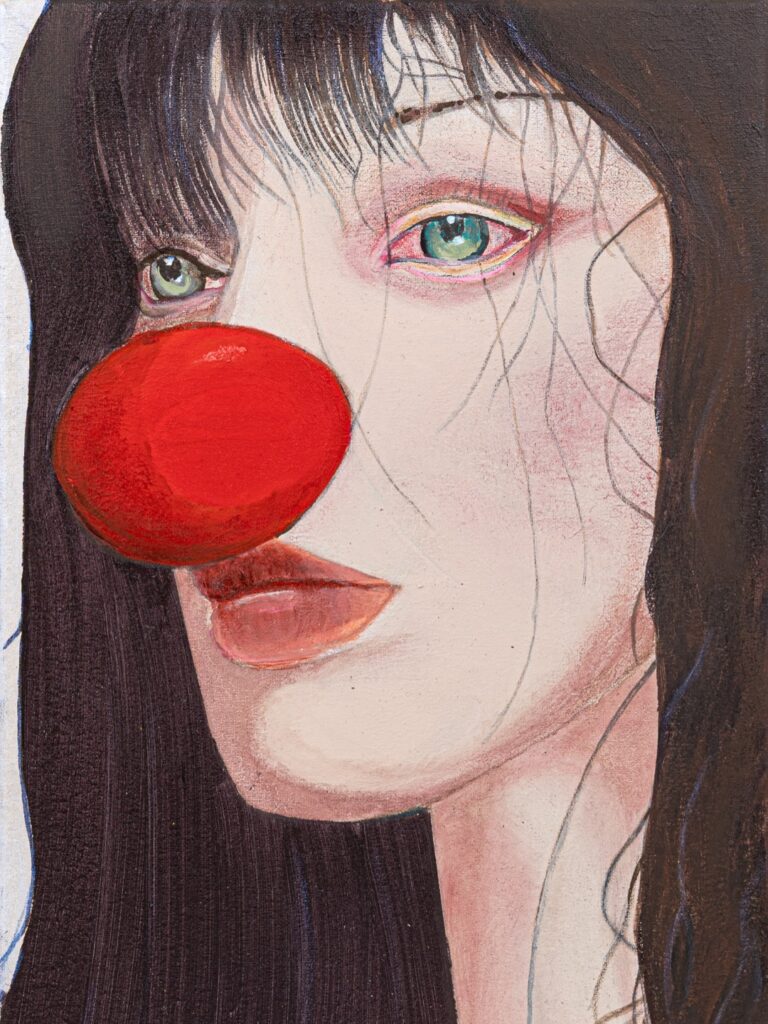
@videoinsightfoundation acquires for the Videoinsight® Collection #videoinsightcollection the work ‘Bella e (simpatica)’, acrylic and oil on canvas, 30 x 20 cm, 2025, by Artist Savina Capecci. The painting was part of the group exhibition “Caregiver,” curated by @rebeccarusso.videoinsight and promoted by @videoinsightfoundation at @magazziniartecontemporanea in Trapani between July 29, 2026, and August 29, 2026.

” ‘Bella (e simpatica)’ is a portrait of a young woman, characterized by
a visual duality. The composition depicts a face with weary features, highlighted by reddish makeup around the green eyes that gives the gaze an almost worn-out quality. The central, dominant element is a red clown nose. This nose — usually a symbol of joy or entertainment — takes on an almost painful, performative connotation. It is the mask that the #caregiver is sometimes forced to wear to project cheerfulness and amiability — as ironically suggested by the title — in order to lift the spirits of the person being cared for, even when their own spirit is exhausted or grieving. The red nose acts like a superficial bandage, concealing the fatigue and the invisibility of one’s own pain. The contrast between the woman’s weary expression and the clown emblem highlights the tension between inner reality and forced performance.” @savinacapecci

The artwork ‘Bella (e simpatica)‘ by @savinacapecci acquired by the @videoinsightfoundation for the Videoinsight® Collection, captures — with raw yet empathetic beauty — one of the deepest and most silent human dynamics: the condition of the #caregiver. Through an authentic and engaging visual language, the work conveys — with extraordinary emotional resonance — warmth, lightness, and a profound understanding of human fragility. The painting transforms the artistic experience into an act of care and comfort. It stands out for its expressive immediacy, depth of meaning, and ability to evoke an emotional response. Through the figure of a woman who is strikingly beautiful yet marked by pain, the artist creates a powerful visual and emotional contrast. The protagonist’s eyes — swollen with sadness and traced by genuine tears — tell a story of depression, loneliness, and physical and mental exhaustion. They reflect the gaze of someone bearing an invisible yet crushing weight, worn down by the daily toil of caregiving. Breaking this tableau of inner suffering is an element that feels alien yet holds immense symbolic value: a clown’s nose. This detail transforms the woman into a living mask. The red nose represents the moral and emotional obligation the caregiver feels compelled to fulfill every day: to act as if nothing is wrong, to wear a forced smile, and to project lightness and cheerfulness in order to lift the spirits of the person in their care. It embodies the paradox of having to be a source of joy and comfort for others precisely while feeling hollowed out inside. The woman’s physical beauty — hinted at in the title —serves as an ironic backdrop to her profound fragility, as she is reduced to the social role of someone expected to always be “beautiful and, above all, cheerful.” Rebecca Russo

Savina Capecci

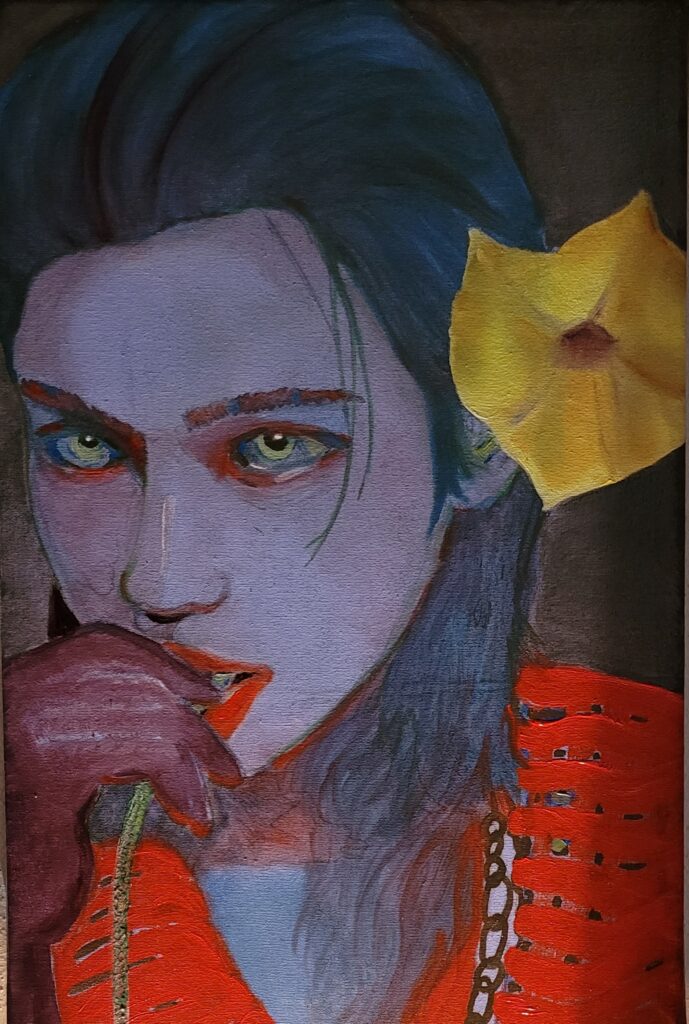
@videoinsightfoundation acquires for the Videoinsight® Collection the artwork ‘NeuroFlora’, an oil on canvas painting (30 x 20 cm, 2026) by Artist Savina Capecci. The painting was featured in the group exhibition “Caregiver,” curated by @rebeccarusso.videoinsight and promoted by @videoinsightfoundation at @magazziniartecontemporanea in Trapani between July 29 and August 29, 2026.” In ‘NeuroFlora,’ a cool-toned face emerges as a welcoming space, while a yellow flower — nestled between the figure’s ear and mouth — serves as a visual metaphor for an inner metamorphosis: the act of listening is never passive, but transformative. For the Caregiver, listening is a process in which the other person’s words, silences, and suffering enter one’s own sensory system, are processed, and bloom into a new form — an understanding that manifests as care, kindness, and closeness. The flower acts as a biological and poetic bridge, illustrating how the lived experience of the care recipient is metabolized by the #caregiver, moving from the ear (receiving sound and story) to the mouth (words that comfort, translate pain, and restore dignity to another’s experience). ‘NeuroFlora’ reminds us that caring for someone requires a profound personal transformation: the ability to absorb the essence of the other and allow it to bloom, once again, as shared empathy.” @savinacapecci

“The acquisition of the artwork ‘NeuroFlora’ celebrates an artistic inquiry that sits at the intersection of art, neuroscience, and profound perception. The painting functions as a symbolic and cognitive device, perfectly aligned with the Videoinsight Foundation’s mission: to promote works that spark processes of reflection, awareness, and inner resonance (#videoinsight).

‘NeuroFlora’ does not merely invite observation; it demands to be experienced through a visual architecture that intertwines and amplifies multiple sensory channels.

Vision. The Eye. The Gaze – The painting embraces the presence of the eye as its primary focal point. It is not merely the organ of sight, but a symbol of awareness, active perception, and introspection. It is a gaze that observes the observer, reversing the roles of viewer and artwork and transforming the act of seeing into one of pure presence.

Listening. Hearing – Alongside the visual dimension, an open yellow flower blooms. Yellow—a vibrant, solar color associated with the opening of the blossom—becomes a metaphor for listening and auditory receptivity. The flower acts as a sounding board or a natural auricle, ready to capture external vibrations and translate them into emotional resonance.

Touch. Contact. Connection – The image of a hand completes this multisensory system, bringing the themes of touch and contact to the fore. The hand is the organ of care and physical connection with the world—an instrument of gestures that shape and explore. It serves as the meeting point between the inner and outer realms, between matter and feeling.

The extraordinary power of ‘NeuroFlora’ lies in the way these elements are woven into a single, unified tapestry. Conceptual: #vision, #hearing, and #touch do not operate in isolation but integrate, evoking a synesthetic dimension. The work suggests that human perception is not a sum of separate senses, but a dense neural and symbolic network in which seeing is also hearing, and touching is another way of looking. Rebecca Russo

Sebastiano Sofia

@videoinsightfoundation has acquired the work “Self-portrait with stoma” (oil on canvas, 100 x 60 cm, 2026) by Artist @sebastiano_sofia for the Videoinsight® Collection. The piece was part of the group exhibition “Caregiver,” curated by @rebeccarusso.videoinsight and promoted by @videoinsightfoundation at @magazziniartecontemporanea in Trapani (July 29 – August 29, 2026).

“This self-portrait stems from the experience of having a stoma — an event that radically transformed my relationship with my body. For months, caring for myself meant performing simple yet essential daily actions: cleaning, dressing the wound, observing, and accepting. It was a ritual defined by fragility, patience and listening. Yet, this act of #care was not merely physical; it was also a mental and emotional exercise — learning to inhabit a changed body and confronting fear, shame, and uncertainty. I did not walk this path alone. The presence of those who stood by me —d octors, nurses, family, and friends —reminded me that #takingcare is always a relationship, a shared act. This painting was born from that experience: it tells the story not just of a wound, but of the possibility of rediscovering a sense of tenderness toward one’s own body, even when it seems to have become a stranger.” Sebastiano Sofia

Sebastiano Sofia’s work is distinguished by a fluid, organic, and evocative painting style, in which the human figure dissolves into metamorphic forms. The application of paint is liquid and layered. Body contours are never sharp or rigidly defined; instead, they appear soft — almost gelatinous or membranous — reflecting the fluidity of the body’s interior and the mutable nature of flesh. In Self-portrait with stoma — an intimate, visceral self-portrait — the artist confronts the complexities of the vulnerable body, the nature of #care, and the reclamation of bodily identity. He lays bare his physical and psychological state regarding the presence of a stoma — a permanent or temporary anatomical alteration that radically transforms one’s relationship with their own body. Sofia’s palette employs organic and flesh-toned hues: shades of pink, visceral reds, pale blue-whites, and areas of warm or earthy shadow. The color is not descriptive in a realistic sense, but rather emotional and sensory. The atmosphere is suspended in time, hovering between the dreamlike and the clinical-anatomical realm. The figure seems to emerge from or sink into the background, creating a sense of privacy that is simultaneously violated and embraced, where the delicacy of the brushwork softens the impact of the medical condition on display. His painterly exploration transforms biological fragility and the mark of illness into an act of pure visual poetry. The work aligns with the primary objective of Videoinsight®: using painting as a psychotherapeutic tool to bring deep inner insights to the surface.

Within the context of the Caregiver exhibition — created to explore concepts of care, dependency, empathy, and physical and emotional support — the painting acts as a bridge between two dimensions:

  • the body as a site of care: the stoma ceases to be a mere clinical detail and becomes the conceptual focal point of the work, a symbol of human vulnerability and the need for acceptance;
  • the act of self-caregiving: even before receiving care from the outside, the figure is immortalized in the act of managing, observing, and inhabiting their own condition.” Rebecca Russo
Milena Sgambato

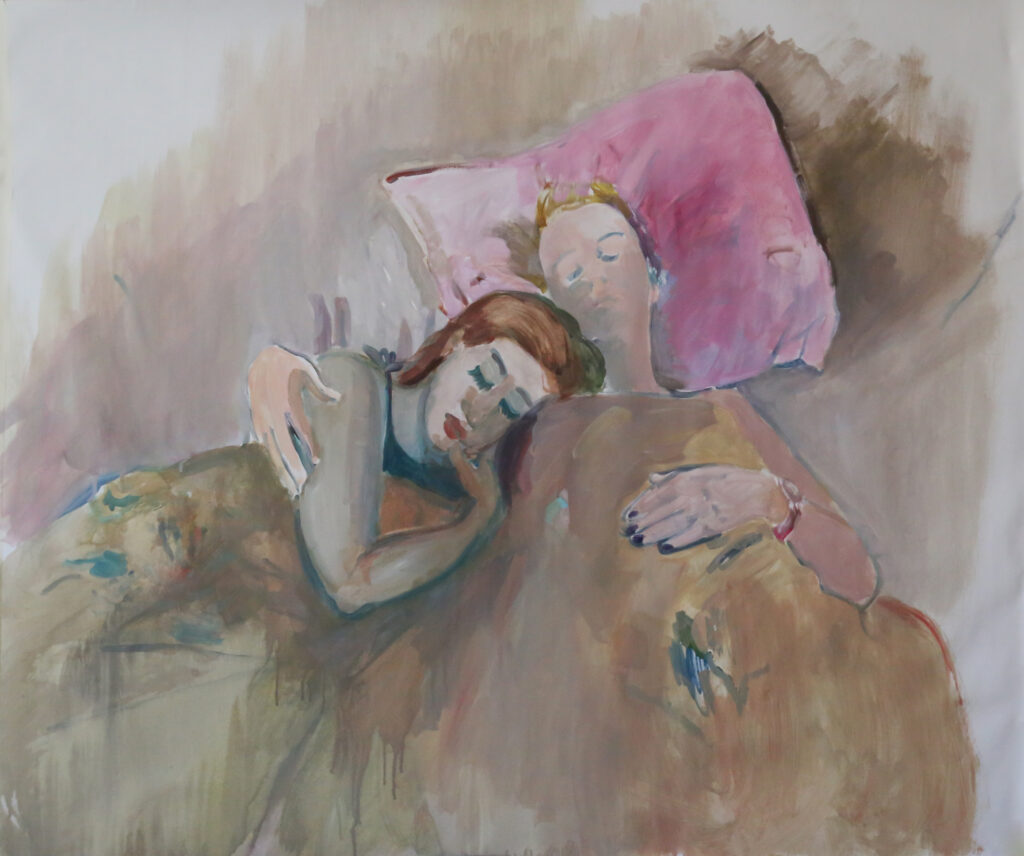
@videoinsightfoundation announces the acquisition for the Videoinsight® Collection of the work “Ci abbracciammo” (We Embraced), acrylic on canvas, 92 x 73 cm, 2024, by artist @milena.sgambato.

The painting originates from the “Caregiver” exhibition—curated by @rebeccarusso.videoinsight and promoted by @videoinsightfoundation—held at @magazziniartecontemporanea in Trapani from July 29 to August 29, 2026. It has been included in the Videoinsight® Collection #videoinsightcollection.

“In ‘Ci abbracciammo,’ the archetype of #care is understood as a profound emotional attunement and a recognition of the other. The two figures, with eyes closed, experience a shared journey. They embody the union of opposites—a true coniunctio oppositorum—in which two souls integrate within a psychological embrace. Vivid details, such as the painted fingernails and the pink pillow, serve as powerful symbols of the Persona—the social and everyday identity that retains its full dignity. The earthy-toned blanket envelops the bodies like a temenos, a sacred, protected space that shields the relationship from the anxieties of the outside world. In the background, fluid brushstrokes evoke the emotional weight and daily struggles that every #caregiver faces to safeguard this bond. The painting acts as a transcendent function, capable of transforming vulnerability into a regenerative force for the soul.” Milena Sgambato

“In the painting ‘Ci abbracciammo’ (We Embraced), 2024, the artist @milena.sgambato translates one of the most universal and visceral human gestures—the act of holding and supporting one another—into the medium of paint. The image fosters introspection, psychological internalization, and insight (#videoinsight). It relaxes the mind, lowers defenses, bypasses censorship, breaks rigid patterns, induces a meditative state, and evokes an emotional resonance. The fluid and energetic use of acrylic, its rapid drying time, and the instinctive, dynamic brushwork powerfully represent life itself: uncontrollable, indefinable, in motion, imperfect, and at times blurred. The layered composition and the interplay of sheer and textured color fields reveal human figures that are not hyper-realistic, thereby facilitating projection, mirroring, regression, and identification. The two women in this connection seem to emerge from a background that is, in itself, a state of mind; they tend to dissolve or merge with the surrounding space, emphasizing the interconnection between their bodies and the physical and emotional environment.

The work’s title, conjugated in the passato remoto (a past tense denoting a completed action in the distant past—‘We Embraced’), evokes the memory of a closeness and intimacy that has become indelible. The gesture of the #embrace transcends a simple display of affection to become a true archetype of mutual support. Two figures wrap themselves in a firm hold, where the boundaries between the one giving support and the one receiving it become intentionally blurred.
The scene conveys bodily, tactile sensations. It is a visual representation of #empathy, where physical closeness facilitates the release of tension and the sharing of emotional burdens. Through a color palette…” …nuanced and vibrant; the painting depicts not merely a moment, but the sense of protection and relief that the moment evokes.

The work—a visual parable about the fundamental need for care—reminds us that caregiving is not a one-sided act or an act of self-effacement, but a reciprocal relationship.” Rebecca Russo

Centro Ceco Milano – Centro Ceco Roma

Centro Ceco Milano – Centro Ceco Roma

Tre Artiste ceche a Trapani per la Mostra Caregiver

10.08.2026

Julie Machallova, Renata Machycková e Zuzana Pernicová sono tra le 21 artiste e artisti selezionati per la mostra internazionale Caregiver. La cura come urgenza, dedizione e visione nell’arte contemporanea, in corso fino al 29 agosto 2026 ai Magazzini dell’Arte Contemporanea di Trapani.

Renata Machycková, Portrait, 2025